Wednesday, January 18, 2012

The Life of an Artist

I was recently invited to be included in a book titled "100 Artists of Washington" by Schiffer Publishing, Ltd. It's always nice to be noticed, but, I was asked to write a little blurb about myself in the first person. This was an uncomfortable situation. It's like holding a spotlight above your head while doing a tap dance. I sat quietly for a while, trying to gather my thoughts. What brought me to this point in life? Why was I an artist as opposed to having a real job with regular income and health insurance? I had done that for a while but, it never clicked with me as my mind would wander off somewhere. Eventually, someone would smack me on the back of the head telling me to pay attention. Was that the key? I wrote:


"Gazing out the window watching a bird hop from one branch to another wasn’t uncommon for me in my early years while sitting in my classroom. Others were learning more quantitative subjects like math and verbal skills. It was that meditative activity that has stayed with me all my life. Art has been my interest since childhood.

My formative years were established in a small town in southern Ohio, Chillicothe. Art took many forms in my life and creativity was at the center although, not always recognized. I studied two years at the Columbus Collage of Art and Design and went on to receive my degree at the American Academy of Art in Chicago. I did teach for a while at the Palette and Chisel Academy of Fine Art, Chicago, the Johnson County Community College, Overland Park, KS, as well as painting workshops throughout the United States and Europe.

My voice, however didn’t establish itself until I moved to the Pacific Northwest in 1990. The Skagit Valley Region of Washington State was my artistic coming of age. It was here where my “impasto” skills emerged and my voice began to bellow. It was here where I discovered that my technical skills were my tools of expression and not the end within itself."


So, that was my submitted response for the upcoming book, 100 Artists of Washington. Did I choose the life of an artist or did it choose me? The idea of working 9 to 5 with regular income conjures up the idea of security and being able to walk away from your job at day's end. An artist has none of that. I don't seem to be able to walk away nor do I have the security of a regular income. I went 11 months in 2011 without a major piece of my work selling. In the past 3 weeks, 7 have sold. That's like getting paid once a year but, that's the norm in this profession. I really don't think of it as a profession as much as an obsession. There are many positive aspects that far out way the negatives. First, no one can fire or lay my off. Second, if the weather is nice, I can chose to go for a bike ride. Mostly though it the satisfaction of delving into yourself and losing all concepts of time and space while coming out the other side with the fruits of your labor(or fruits of your play).
www.alfredcurrier.com


Saturday, January 14, 2012

"Art for the Heart" raises over $8,000


"Art for the Heart" raises over $8,000 entering its third week.
Proceeds to go to selected non-profits that support basic human needs and the environment in which we live.

Come visit my open studio.

see: www.alfredcurrier.com

Saturday, January 7, 2012

Monday, December 5, 2011

Formation of a painting

This is a very simple application of a creative thought. I have been studying ravens for the past several months with some in compositions that have been fun. I believe that I've only scratched the surface so, with no further explanation, please find Formation in it's development stages.


Tuesday, November 22, 2011

Painting Haystacks

I chose the title "Painting Haystacks" since it does describe the approach of my work. I'm referring to Claude Monet's repetitious, and what appears, duplications of haystacks and other motifs.

To understand this, the artist is NOT duplicating paintings but, instead, exploring color , texture, and all of the complexities that confronts him or her in the process of creating art.

Recently confronted by an artist, I was asked if I got tired of painting tulip fields. I had to smile at this question because, this artist wasn't that familiar with my work. Yes, the migrant workers and the tulip fields of this Skagit Valley region of Washington State do contribute about 30%-40% of my work but, I also paint other motifs as well. As a business decision, I tend to send these works to galleries outside this region.

In the small study of "Alla", I was exploring the migrant farm workers from a pencil sketch. The oil study allowed me to work out the invented figures. For the final painting "Unison", I used the figures as a center compositional tool so the eye of the viewer did not go directly to the sun. The idea here was to stop the viewer so he or she would explore the painting. Now, all that I said in this paragraph are learned techniques that I've acquired over the years of working at my "craft". 
But, Fine Art is my goal here, not craft. This is what binds "Unison" and "Snow Valley" together. These two paintings, although a similar subject matter of past paintings, are not duplications. These paintings are the exploration of color and texture. To be specific, an exploration of the saturation of color provided by intense sunlight. Within each value range of color, I have broken the color down in triads of color application.

With the music playing, I dance with my brush and palette knife, lost in the process of painting and seldom acknowledging my subject matter.


Wednesday, November 2, 2011

Plein Air Studies Inspire Studio Works

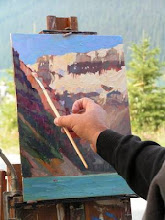
When I travel and paint en plein air, I keep my studies rather small, 8x10-11x14.  This seems to fit my needs.  I suppose I could just carry a camera but, I find the absorption of the experience is what carries my creative energy to my larger works.  It's about the process of doing for me as opposed to the end product expected.  I do use photographic reference on occasion so, I'm not an "I paint only from life" artist (see my last blog titled "Ravens"). 

So, why would I just enlarge a painting that I'd already done?  The answer is pure and simple: the plein air painting was a reaction and depiction of my environment of that particular day without much creative thought.  A lot of what I do in the studio is creatively-driven as opposed to technique-driven which is what plein air seems to demand from most.  I love the creative process to art and consider techniques only the tools of expression.  I do not feel that technical wizardry is the end within itself although, I do appreciate fine craftsmanship in all disciplines.  Sometimes craft is confused with art.     

As some of you may already know, I was invited by artist James Moore to join him and a few other artists on a painting trip to Glacier National Park this past June.  I was completely blown away by the beauty of Glacier and extended my stay by three weeks.  I had completed 22 paintings on location which will be featured in my upcoming visual chap book: Alfred Currier: Glacier National Park 101.  This book will be released in February 2012 at a show of this work at Howard Mandville Gallery, Kirkland, Washington.  Included in this show will be several large paintings that have been inspired by the plein air studies.  Seen below are three finished works with a few start photographs to show my process.

plein air study for large works
Goose Island was so magnificent!  It was also a tour bus stop that netted no fewer than 100 tourists looking right over my shoulder.  I'm used to occasional on-lookers but, this was too much.  I was so surprised to see this little study when I returned home.  I thought is was going to be a disaster but, it was one of my favorites.  The large painting became an exploration of fragmented color.


"Goose Island" Glacier National Park, MT 24x30


Many Glacier was one of the windiest paintings of the trip.  I hid behind a little tree and stacked rocks on my French easel 'til I thought the legs would break.  Luckily my 40 year old friend held up.  I searched for subject matter in this painting but, I didn't realise that it was the atmospheric perspective that drew me in when I started this large piece.


"Many Glacier"  Glacier National Park, MT 24x30


"Lake Saint Marys" Glacier National Park, MT 24x30
Lake Saint Marys was my first plein air painting at East Glacier.  The incredible light made this a no-brainer. 

Seldom do I like my paintings when I finish them because I'm too close to them and all I see is the struggle.  I have to put them in the rack to season a while.  After a few weeks, I can pull them out and see them as others do, removed from the process.

Friday, September 16, 2011

RAVENS

Last May, I took the Alaskan Ferry from Bellingham, Washington to Juneau, Alaska.  This was a trip up the Inside Passage with several stops along the way.  I chose the Alaskan ferry because cruise ships are too large to navigate these narrow waters and I wanted to experience the voyage to it's fullest on my first trip to Alaska.  My final destination was Juneau with whale watching and hiking planned.

Early one morning, I find myself sitting on a park bench near the state capitol building in Juneau.  A very large black bird lands on the back of the park bench with me.  He clucks and makes strange sounds, then flies away.  I sit and observe.  There are ravens everywhere, it's 6am.  They skip, run, fly, and observe.  They watch me watch them.  One picks up a piece of string and drags it around for a while, then drops it. Another flies in and grabs the valuable string, then flies off with it. 
I notice a raven with what appeared to be a purple bead in it's beak.  He walks around, drops it, squawks, and picks it up again.  I stand and walk towards him, he skips away.  I follow and he runs. I stop and so does he.  I go back to my bench and sit. 

Again, a raven flies in and lands on the other side of my park bench, hm-mm(?), is he the same one as before? 

Over the next few days, I return to this spot with a keen eye of just observing these guys (and gals).  Their antics are amazing.  One does a tumble a few yards away.  What was that all about?  They seem to have this obsession with carrying things around, digging, and talking.  They have some interesting reflective color in that deep black, soft and hard edges with violets, blues, and greens.  The wind ruffles their feathers, an unkept look as if they'd just got out of bed.  Their heads twists and turns as if they're trying to understand.  I catch my head doing the same, trying to understand.
contact information:

Subscribe in a reader