Friday, June 11, 2010

Umbria, Italy 2010, the advance party to Torgiano

Umbria 2010, the advance party to Torgiano

Two hours north of Rome, we arrived in Torgiano, Italy five days before the workshop attendees. This advance party consisted of artists Anne Schreivogl, James Moore, and Alfred Currier (yours truly). Executive Director of the Pacific Northwest Art School, Sue Symon, accompanied us as we were greeted by local artist Tony “Torgiano” Turpin. The purpose of our advance party was to iron out certain logistics and scope out painting locations for the next 11 days.

Torgiano is a very quaint little Umbrian town, seemingly untouched by the tourist mania that is ever present in other popular European destinations. James, Anne, and I salivated at the potential painting we had at hand. Almost immediately, we headed for the plaza for our first plein air adventure. We broke the ice! The next day, a streetscape of the bell tower, we’re on a roll. Off James Moore and I headed for the vineyards and walked about 4 miles back because we had no car but, a good day. Tony Turpin dropped Anne, James, and me off past the town of Brufa for a day of painting. Now, for your interest, James and I were equipped with our backpacks and lightweight “pochade” boxes. Anne, however, decided she’d bring her trusty, but heavy, French easel. Six miles from home, we head back taking turns carrying Anne Schreivogl’s French easel. As we turn right on the street heading back to our hotel, Anne grabs her French easel from James and proceeds with a high-stepping, arm-swinging gate for the final sprint to the front door! (hmmm?, store that in the memory bank)

Day five, the group of 17 arrived with rain clouds in tow.

Monday, April 5, 2010

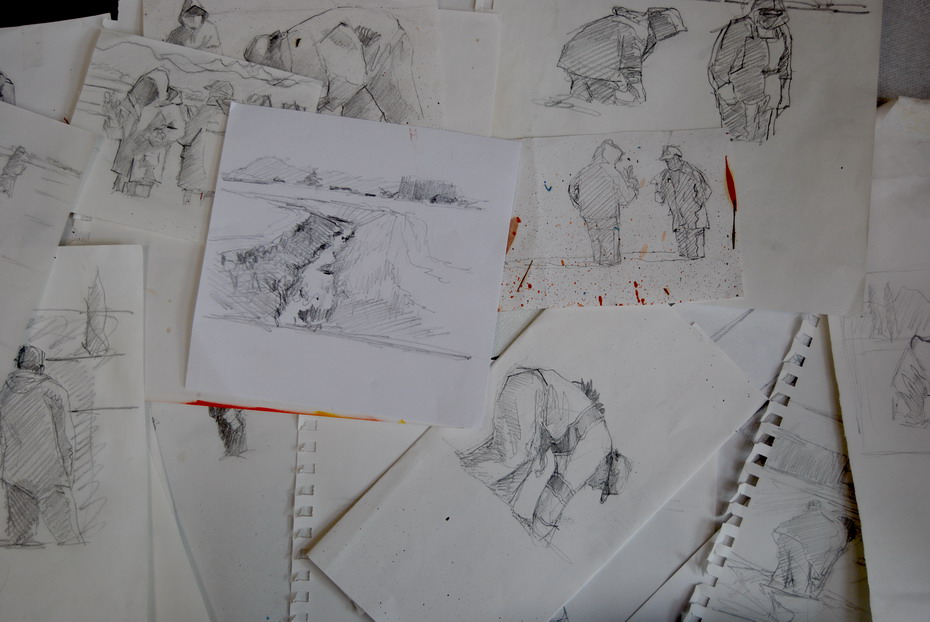
Drawing connects me to painting

Many have asked me if I paint from photographs.  The answer is that I have in the past and will in the future but, it's a rare occasion.

I was involved in a show in Chicago in the late 80's with a group of young artists that are now very well known across America.  Afterwards, we had dinner together and one made a sweeping statement: "Only paint from life!"  Later that year, I was in Kansas City at an artist function.  As we all were sitting in a circle, we were asked to introduce ourselves and say something about our work.  As we worked around the circle, an artist exclaimed: "I only paint from life!"  The next artist said very quietly: "I try not to limit myself."  That artist was Dean Mitchell.

This last painting, "Tulip Chat," is a 12x9 oil on birch plywood.  This painting was conceived from my sketchbook.  During the year, I fill up sketchbooks with simple drawings that I call upon to help make my compositions for my studio work.  My goal with this piece was to paint a simple "alla prima" painting of some tulip workers. As I do these small works, I become familar with the subjects and will later place them in a larger impasto painting.  All I'm looking for is the essence of what is in front of me, "less is more."

I do like the creative engagement to my art, whether in the studio or plein air.  For the most part, my sketches are done on location but, I will also draw from photos when the inspiration moves me.  All of these simple value drawings are kept for future paintings.  Some of the figures have been used in muliple paintings.  Sometimes I'll pass them on to the patron who purchases my work.  Now, my paintings are either from life or from my sketchbook.  The photographs I use are for the purpose of drawing, not painting.  What I have realized as a personal trait is that if I paint from a photo, I become a slave to that photo and my paintings become just a little too detailed for my taste.  The results feel like manufacturing as opposed to fine art.  If I paint from sketches, I get to invent and that's my creative outlet.  "ONLY" is a dangerous word! 

Saturday, March 27, 2010

Tulips are starting to shine

The Skagit Valley is starting to bloom.  For the next couple of weeks, starting right now, "there are no bashful hues" says Tom Robbins in Another Roadside Attraction.  Indeed, my home region in Northwest Washington State is ablaze!


Sunday, February 28, 2010

Margaritaville-Key West

With enough frequent flier miles, I pondered where to go mid-winter-a place to warm the bones and find inspiration for painting; some place warm and exotic within the U.S. yet different than Mexico or Hawaii. The answer: Margaritaville! Time for a a painting trip to Key West, FL. During the week, it was warmer back home, but with a new place to explore and brushes in hand, I was ready to put oil to canvas.
Notes during the trip:
There’s a muffled quality to the sound in the air here, and I haven’t been able to grasp the source. Is it the ocean? The humidity? When I actively listen I hear the rustle of wind through the palm fronds, the occasional car go by, and the screech of an island bicycle stopping for a light.


Tourists have many options for transportation here. Some opt for the oversized electric golf carts that look downright fun for toodling around in. The $90/day price tag took ‘fun’ out of it for us, so we opted to rent bicycles-perfect on the flat wide streets.

These are no ordinary ten-speed drop-handlebar bicycles. Upon mounting mine I immediately flashed back to my days at age 10 riding my fat-tired steer horn handlebar bike. Backpedal to break, and with only one gear. Yesterday we discovered a great paved trail around the island and pedaled its entirety in a little over an hour, passing turquoise waters and sandy beaches.

I’ve been gathering facts like candy and would like to leave with a bowlful. Key West is at 24 degrees N latitude, just 1 degree North outside the tropics. It is closer to Havana,Cuba-90 miles- than Miami (160 miles). It’s the southernmost point in the Continental U.S.
And I learned why the sunsets are so big here-why so many gather at the Pier every evening: Most East Coasters never see the sun set over water! Being from Washington State: uh…where else would it set…?

I could not name most of the animals or plants that I see here. Large buzzard-like black birds soar for hours on warm breezes. Green foliage-spiky leaves, gnarled branches hide many of the houses in the neighborhood. These old homes are predominantly white with shutters over windows. Geraniums and tomatoes have no fear of frost and grow uninhibited. I, however, feared frost as it was chilly last night, the air conditioner continued to churn out the cold air; these old homes do not have heat. In an attempt to warm up, we made our way down Duvall Street to the Butterfly Conservatory, where it’s a constant 85 degrees. It turned out to be the highlight of the trip as 2000 winged jewels flew around us, some landing to rest for awhile. By weeks end, we completed our stay and began our own winged migration back home, to balmy Skagit Valley.


Saturday, January 16, 2010

Fine Art, tools of expression

I had mentioned in an earlier posting that I considered my education and learned techniques as my "tools of expression." I reiterate this because it would be so easy for an artist to get into the manufacturing mode because of the pressures of living in this fast paced society. The more we use the computer with all of it's opportunities, the more we seem to develop an Attention Deficit Disorder, ADD, to life. Small bits of information that are processed quickly like the sound bites of evening news or Twitter comes to mind. I bring this up because I am a victim of this too and I have to remind myself to slow down, take a deep breath.

If I were to head out to the Valley (Skagit Valley Washington) looking around for a "formula" painting, it would be rather easy to find one. I need more than that. I need emotion. Sitting on rock with sketch book in hand, absorbing the day, and being a voyeur to the present, I watch the trickle of water moving down the slough. My eyes move along the curvature of the bank, each twig and blade of grass now coming into focus. Ten to fifteen minutes pass before I set my pencil to the paper. I'm establishing the values and contemplating the color. I write notes on the side of my drawing, "subtle shades of blues and cool greens in the shadows with some grayed reds beneath." The blaze of tulips are almost blinding but, I ignore for the time being since the fields are brown and tulips won't bloom for a few months. This is how the mind wanders when you slow the processing. As I'm sitting there, I notice a hunter in the distance, hardly moving. I contemplate entering him in the composition but, decided not. Still, I cannot keep my eyes from him. He moves one leg forward in deep concentration, herons are fascinating. Can you imagine a heron on Twitter? Back to my drawing, I wonder what this delta region of the valley would be like without roads, dikes, and sloughs. I imagine that there must have been tens of thousands of birds, flying, squawking, and just standing still like this great blue hunter. A certain bonding feeling comes over me as I sit here. The painting I'm contemplating is much too large to paint outdoors so I close my sketch book and sit for another ten minutes.

A couple weeks or so have passed. I've painted this slough before but, I've never painted this painting before. It's a new experience. I still see the hunter and wonder where he's standing now.

"Trickle to Sea" 36x48

Thursday, December 31, 2009

Richard Schmid, The Landscapes

I just finished reading and perusing Richard Schmid's new book on landscapes. It's no surprise to me that this book shows some of the most incredible works of art by a living artist today. He is and always has been a star that is just out of reach from us all.

The Palette and Chisel Academy of Fine Art, Chicago, was where I met Richard Schmid. We both served on the Board of Directors and Richard was president. This was in the mid 1980s when some great emerging talent adorned the halls of that old mansion in Chicago. Richard's generous mentoring spawned some of the great names in contemporary realist art in America today. This is the Richard Schmid I know, unselfish and extremely focused in his world of art.

I recommend this new book, "Richard Schmid, The Landscapes", Stove Prairie Press. see http://www.richardschmid.com/ The hardback edition is $135.00 and worth every penny.

http://www.alfredcurrier.com/

Wednesday, December 9, 2009

How many months in a year?

Are you sure you want to stick with your answer of '12'?
And what is a dry-seasoned year referred to? Maybe El Nino? Are you sure?

We understand beliefs vary widely from person to person, but we count on the consistency of solid facts. This reminds me of why painting commissions can be so difficult. Betty wants a French cafe painting scene with bright red awnings. We work out the details and a month later when I show her the completed piece, she says, "oh, not that color red". Everyone sees color differently, and, everyone sees the world uniquely.

How about the Chinese farmer trying to explain the unusual hot, dry weather one year? El Nino? "The traditional Chinese lunar calendar follows a system in which a month must be made up every fourth year- sometimes there is an extra ninth month, or an extra second month, and so on. This year is the fifth one. Whenever there are two fifth months in one year, you can count on a hot dry spring followed by an extremely wet summer. This is the way it has been in the past, and thus the peasants [farmers] are not surprised by the current heat and dryness. Everywhere in the countryside they complain quietly about the problems of having two fifth months in one year." -River Town, Peter Hessler

Question your assumptions. Is it really like this or like that? There are many truths.
The opportunity for expansion of ideas and awareness, whether of the world or towards art, comes from this constant questioning and observing.

Here's how I see red.
Do you see what I mean by red?

p.s. Colors may vary according to individual monitor settings. ;-)

www.alfredcurrier.com

Subscribe in a reader